Buy Tickets
Doors 8pm / Show 8:30pm
$23 adv / $25 door / free or discounted for members
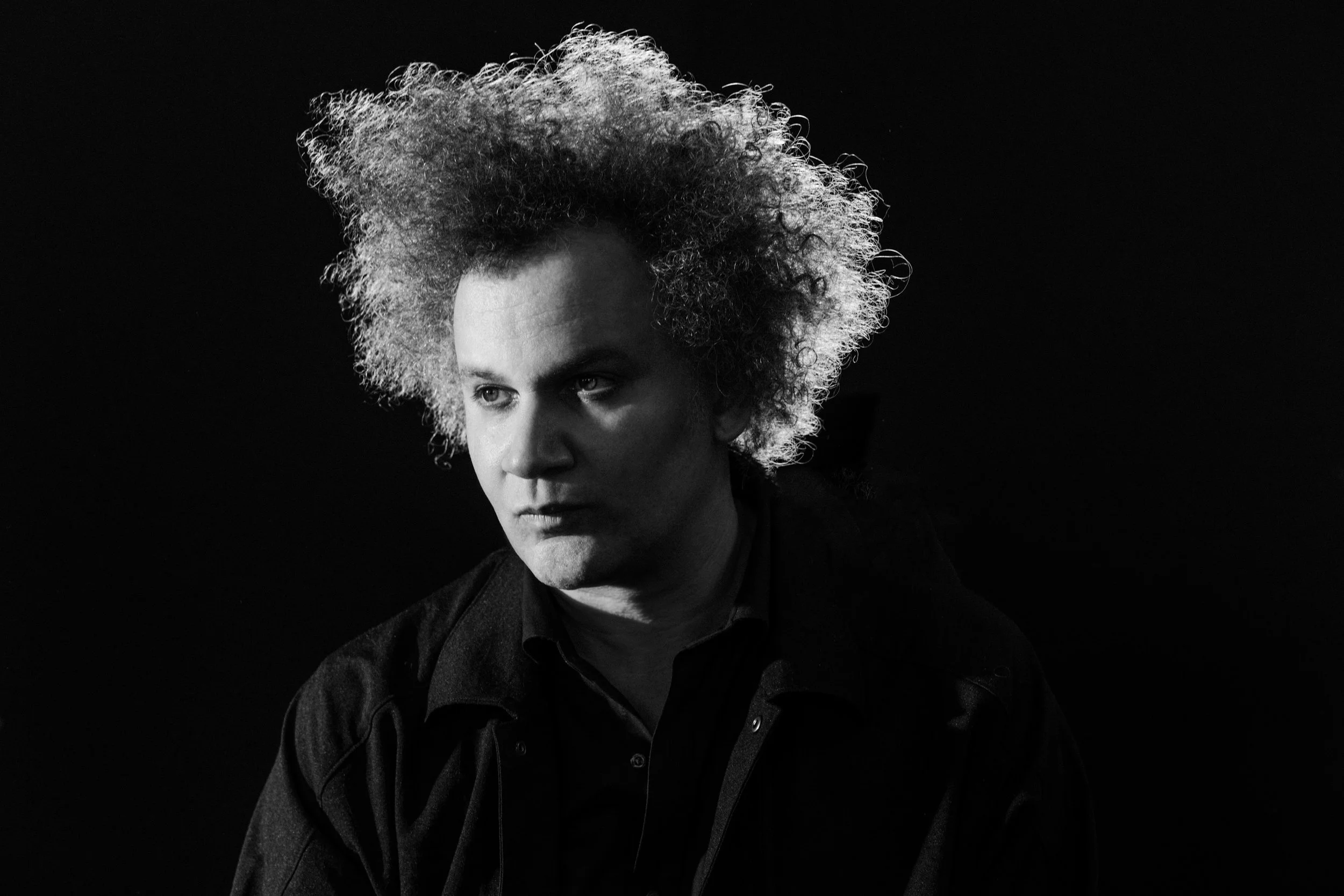
Tyondai Braxton’s Splayed Werks is his fifth album and first full-length release since the recording of his 2018 symphonic work Telekinesis. A co-founder of acclaimed experimental rock project Battles, among many other achievements, Braxton’s work spans electroacoustic projects and contemporary composition.
Matt Robidoux (they/he) is a San Francisco based composer, improviser, and educator interested in sound-gesture causality and the convergence of movement and sound as it relates to free improvisation and accessibility. Their primary instrument is the “corn synth” (Kinetically Operated Randomness Network), a modular system that interprets physical input from two “ears of corn” sculptures cast in aluminum.
—
“My philosophy on releasing music has changed a lot, but also my idea of what it means to be an artist. The important part of the artist’s job is to archive what you're doing—what you're excited about, what you're dealing with, what you're reacting against—putting that in a form that documents your life… At the moment, we're all looking out into the world, dealing with the helplessness in a time of war, media over-saturation. What's the role of the artist in that? I think the archiving of any particular creative idea in the moment is one of the most significant things an artist can do now. Things I previously thought were important—’this piece means so much to me,’ or ‘listen to how this chord arrived’—are actually much less so.”
Even at first blush, Splayed Werks, Tyondai Braxton’s fifth album, his first full-length release since the recording of his 2018 symphonic work, Telekinesis, reveals itself as unlike what came before and marks the beginning of a new chapter with UK label Erased Tapes. First off, there’s a lot more music here, 70+ minutes of pure electronics and sound design. Plus, it’s divided in a way that’s out-of-step with the longer forms the 47 year-old composer/producer has previously imagined into being. Of the album’s 15 tracks, more than two-thirds are sub-five minutes.
The album brings together mostly newer works alongside pieces composed across the past decade, some of which appeared previously as standalone releases. To fully represent the scope of this period, Braxton incorporates the Dia / Phonolydian (2022) and Multiplay (2023) singles into Splayed Werks, foregrounding the project’s long-form compositional arc. Along with “Salt Point” and previously unreleased commissioned works such as “4 Zones” (2018) and “K Space” (2021), these pieces were always part of a broader, evolving body of material. Here, they are re-edited as newer versions and remastered by the excellent Matt Colton at Metropolis Studios in London and woven into a continuous narrative. The result is not so much a compilation, but a record that traces its own lineage in real time: a body of work composed across years, now fully realized as a single, cohesive statement.
What the circumstantial facts can’t reveal is the social, in-real-life context of Splayed Werks, an expansive episodic work that plants a musical flag on a turbulent period, and on which darkness and ambiance, rhythm and light, instinct and precision, organic textures and messy playfulness all share space. These Werks take stock of a constantly evolving world, as well as the evolutions experienced by their creator.
It may be a perfect album for 2026, a time when the sonic landscape continues to fervently embrace increasingly radical hybrids, at once club soundsystem-ready, art-installation-leaning, and music-school-mediated. But also, importantly, intuitive and hand-crafted. It’s no stretch to say that Tyondai had a hand in building this world. His two decades-plus-long career has seen him co-found electronic prog-punk heroes Battles (which he’s described as “a laboratory that masqueraded as a band”); performing as a duo with Philip Glass; write numerous electro-acoustic and chamber commissions for celebrated American new-music ensembles such as Bang on a Can All-Stars, Alarm Will Sound, Third Coast Percussion, Brooklyn Rider, and Yarn/Wire; having his “part installation, part band” HIVE project appear at The Guggenheim Museum, Sydney Opera House, and a 3-night residency at Big Ears Festival; and deliver a series of technologically ambitious, at times orchestral works for lauded labels of electronic, experimental and future-music, Warp and Nonesuch Records.
Meanwhile, the world outside has also radicalized. Mechanisms behind the creation, promotion, distribution and broadcast of new experimental music have been violently disrupted, even as audiences for it have grown. In the post-COVID streaming age, juxtapositions like “popular” vs “underground,” and “album” vs “collection” vs “project” have been more in-flux than ever before. The volume and acceptance of previously neglected ambient and contemporary classical sounds has been tempered by a lack of critical context, seeded with algorithmic buffoonery and AI fabrication. Such tensions enlighten not just the make-up of Splayed Werks, full of music recorded between 2018-2025, but its relatively simple sonic-collage forms.
The Splayed shapes and structures have also been influenced by the transformations in Braxton’s personal life. That Tyondai is now a father may not come as a surprise, but the fact that the man who rebelled against his formal music-school education in the late-‘90s, has, in 2022 become a professor of music composition at Princeton University, does. This lifestyle change—a full-time academic gig, escaping the careerist hamster-wheel beholden to commissions and collaborations, a home studio as his own workshop and testing ground, with the desire to finish things and the perspective to not be precious about it—is also key to the album’s sound. Braxton’s time is his own, and his idea of what it means to be an artist in our time has evolved as much as the surroundings. This too is what Splayed Werks is about. It may be a cliché to call each ensuing album by a veteran artist their “most personal,” but it’s no stretch to say this one best reflects who Braxton is in 2026.
As a portfolio, Splayed Werks hews to the menu of a dance music meets minimalist electronic composition, a throughline that stretches from IDM absurdists like Aphex Twin and Autechre, to contemporary immersives like Mica Levi and Laurel Halo. (And, to a lesser degree, to Braxton’s comrades and occasional collaborators, Kieran “Four Tet” Hebden, Jeffrey Cantu-Ledesma and Ben Vida.) It’s a world in which the multitude of dirty rhythms strays far outside club-land’s big rooms—though one can imagine expert mixing hands and a world-class soundsystem transforming the dubwise lo-fi linearity of “Oslo” into a psychedelic wonder, while the interplay between the bass-synth and the constantly deviating shuffle on “UnFS” may qualify as a leftfield banger. And its composed beatless spaces have little to do with current ambient proclivities—the at-once aggressive and ecstatic, panning miniature, “Realistic Water” sounds like power Laraaji.
The spectrum of Braxton’s ideas and directions reveals a voracious mind at play, changing up without overcomplicating the proceedings. Two different pieces called (fittingly) “Multiplay” layer and connect skittering textures in beatwise whimsy, before giving way to a droning dread and organised noise; yet each is adorned with birdcalls to balance the synthetic with the pastoral. “Nimble FX” is also built on hyper-jittery stop-start rhythm lines, and great big cinematic synths. All this music feels fluid, seemingly ready to change in the moment rather than having been dependent on some grand design. Meanwhile, longer, older, more spacious compositions like “4 Zones,’ whose short parts assemble into a narrative-free sound design, and the closing “K Space,” whose chaotic ambiance gives way to what sound like Moog hits, are more grounded, their inclusion shaping Splayed Werks into a multidimensional space, instinctive in how it all fits together.
“Every record I’ve ever finished, I’ve been shocked with what it is. I’ve never known it was finished until it was. Then you get to learn about it retroactively. If I’ve done it right, the finished thing will feel like its own personality, its own being, its own vibe. [Splayed Werks] included.”
—
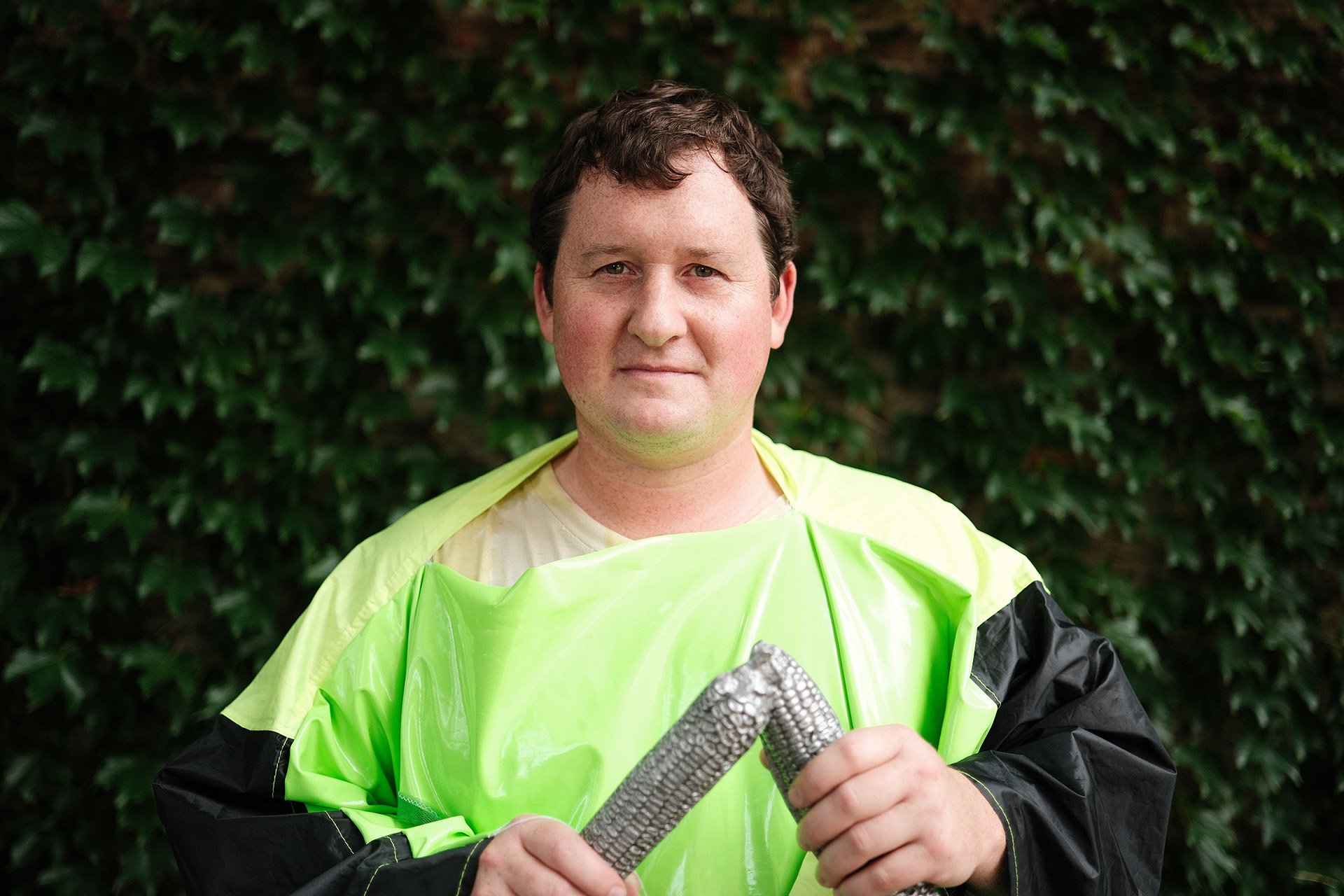
Matt Robidoux (they/he) is a San Francisco based composer, improviser, and educator interested in sound-gesture causality and the convergence of movement and sound as it relates to free improvisation and accessibility. Their primary instrument is the “corn synth” (Kinetically Operated Randomness Network), a modular system that interprets physical input from two “ears of corn” sculptures cast in aluminum.
Why corn?
I like to focus on the modularity/ubiquity of corn and this kind of illogical sculptural sound causality as a starting point for free improvisation. The instrument was invented during my residency at ACRE in Wisconsin, where I cast two corn cob moldings in aluminum at a metal pouring workshop in a cornfield. Movement and touch determine the parameters of pitch, velocity, and duration. This makes for an accessible instrument, at once charming and absurd, while also a merging of my practice creating space for unrestricted musical improvisation..
The modular environment, configured around two touch controlled aluminum cast ears of corn, is informed by my ongoing work with Pauline Oliveros' final project AUMI (Adaptive Use Musical Instrument) in direct collaboration with the disability community and multidisciplinary arts organizations in the San Francisco Bay Area. The powerful echo and artistic legacy of Mills College CCM (1967-2022) resonates in my design of the corn synth, modeling it after the Buchla 158, the original synthesizer used at the San Francisco Tape Music Center beginning in 1963.