the wet and the dry
the wet and the dry
Introductory essay by Andrew C. Smith
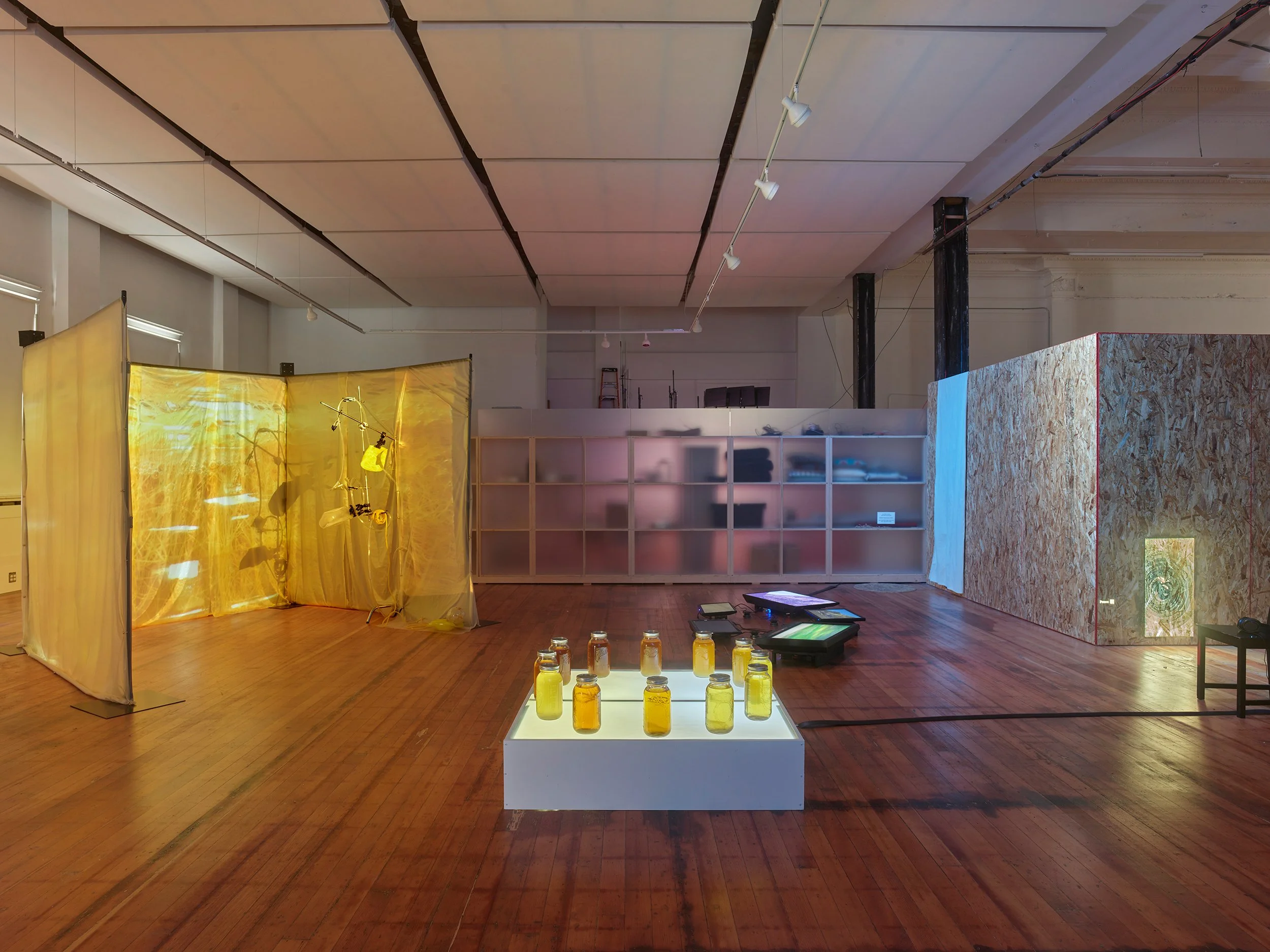
the wet and the dry marks the first group exhibition in The Lab’s three-year series the compost pile. The project challenges the way we think about boundaries—as membranes, as interfaces, as opportunities for collaboration—through four major works by Bay Area artists assessing correspondences between species, scale, microbes, the living and the dead, life and non-life.
The exhibition takes its name from common advice about home composting, balancing wet (or green) nitrogen-rich matter with dry (or brown) carbon-containing material. This balancing act creates optimal conditions for chemical and organic processes to operate, ensuring that the decaying matter breaks down evenly and cleanly to create a rich soil web. The mixture of wet and dry materials is successful when the boundary between the two is dissolved.
But boundaries are often fluid—as sites of correspondence across which material moves—and as such can also be thought of as a form of interface. The writer Branden Hookway points out how the earliest uses of the word “interface” were meant to create a distinction from the “surface,” which contains sur-, or above, an etymological embedding of hierarchy, and a consideration of inside and outside rather than the in-between. Hookway notes that the interface “does not primarily refer back to a thing or condition but rather to a relation between things or conditions, or to a condition as it is produced by a relation.” Furthermore, this relation creates the boundary and therefore creates its elements: “The issue of how elements produce interaction is inverted in cultural situations to encompass how interaction produces its elements, whether human or machine.” The coherence and production of any given entity is a product of the system of interactions it operates within and across; the distinctiveness is produced by the interaction across the boundary, through the interface.
At the cellular level, interactions across the membrane of a cellular wall might blur the line between chemical and organic process. Microbiologist and philosopher Kriti Sharma writes that a cell “is not exactly reacting to an environment, but is reacting with an environment, as oxygen reacts with iron and where both are transformed.” Sharma’s analysis—of course the cell changes its environment, just as humans change ours—points to a further dissolving of the boundary between chemical processes of the non-living (such as the rusting of iron) and the metabolic processes of the living that take place within a cell. This co-transformation of entity and environment can be understood in general terms as entities transforming one another, and is not unique to the domain of life. In Hookway’s terms, these two entities are produced by their relation.
But Sharma progresses further than the model of discrete entities reacting, perhaps because the idea of interaction “producing its elements” implies a kind of stability of the elements once they’ve been produced. Rather, this co-production of entities through their relations happens in the moment, every moment. Sharma writes that:
The organism, sensing apparatus, and external object do not interact with or react with one another (that is, they do not cause changes to each other by virtue of some intrinsically existent causal power). Neither do they remain the same objects that change (or are transformed) over time. Rather, they arise new in each instant.
Arising new each instant, the world exists only through its relations, and we bring about an assessment of those relations moment-by-moment. This constant assessment is integral to our perceiving and operating in the world, and with this we both evaluate and create a model of the world around us. Or as Sharma cites biologist Humberto Maturana and cognitive scientist Francisco Varela, consciousness is an act of “bringing forth of a world through the process of living itself.”
* * *
This exhibition is the first in a three-year series focused on the compost pile as a mechanism and site. In addition to fixed works for gallery format, the project includes as well a performance series intertwined with our ongoing programming. The current season has featured Beth Stephens & Annie Sprinkle’s An Ecosexual Walking Tour In Search of the Elusive Boobie Bird in collaboration with Cushion Works (October 2025), Félicia Atkinson’s Space as an Instrument (November 2025), and Jeremy Toussaint-Baptiste & Evicshen in collaboration with The Wattis Institute (February 2026). As Donna Haraway writes in the ubiquitously cited Staying with the Trouble: “[We] require each other in unexpected collaborations and combinations, in hot compost piles.”
Thank you to Teiger Foundation for their support of this project through their special initiatives grantmaking.
Bill Basquin: Scent Posts, for Carolee Schneemann (2026)
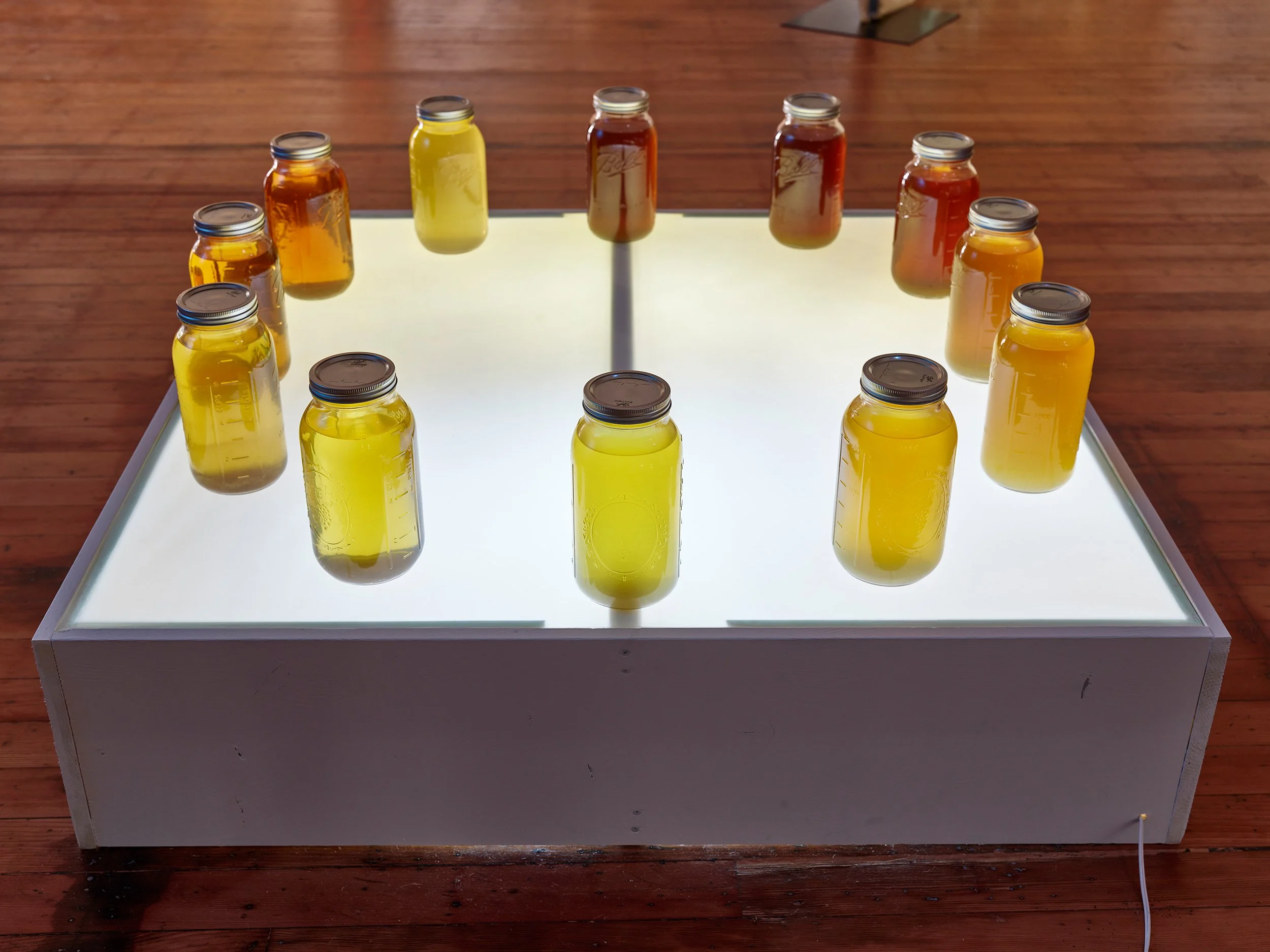
Scent posts carry the forest’s news. One animal urinates and another can tell all kinds of things about them from what they smell—sex, age, reproductive readiness, and health.
When I made the first iteration of this piece (Scent Posts, For Farley Mowat (2015)), I was in the midst of camping on and off for a few years in the Mexican Wolf Repopulation Area in New Mexico (I will show the resulting film, From Inside of Here, at The Lab in June). I thought a lot about human-as-animal, my urine as a resource (moisture and nutrients), and my urine as a source of information. I asked a biologist once at a party what the animals in my research area could tell from my urine. She said they’d know I was human. What else they’d know, she said she wasn’t sure. Would they know I was trans? A vegetarian? That I longed for family?
The main character in the movie Never Cry Wolf (1982), based on Farley Mowat’s 1963 book of the same name, spends a day drinking tea and beer in order to scent-mark the circumference of his campsite. That scene in the film stuck with me as I camped in New Mexico, and I had a desire to situate my practice with Carolee Schneemann’s Interior Scroll, Annie Sprinkle’s Post Porn Modernist and Ana Mendieta’s Silhueta Series.
My urine took on additional meanings when I underwent treatment for breast cancer beginning in October 2024. Urine, feces, and other bodily fluids carried chemicals that could be toxic to my partner; the consulting pharmacist advised me to flush twice after every use of the toilet and wash my clothes twice, separately from the other household laundry. During those four months, the effect of the chemotherapy chemicals in my body was so dramatic that the septic system to which I regularly make contributions was thrown off-balance and needed professional intervention.
Though I completed chemotherapy about a year ago, cancer treatment and its aftermath continues; the urine in this iteration of Scent Posts enacts a visual register: three jars with very dark urine are the hours after each of two iron infusions in March (treatment left me severely anemic and iron deficient); two jars with medium-dark urine are the hours after anaesthesia and surgery to remove the chest port on Tuesday 31st March 2026. Cancer treatment famously ruins your health in order to save your life and the recovery to my pre-treatment physical capabilities is estimated to take two to three years.
The best thing about cancer treatment is the nurses: thanks to Lisette Barajas, Brittany Cassar, and the pharmacist Homa Mirzazadeh for consulting on the color of my urine. Thanks also to Jennifer Burns and Zach Lipson for other kinds of excellence.
—Bill Basquin
* * *
Bill Basquin’s Scent Posts, for Carolee Schneemann (2026), consists of twelve jars of the artist’s urine in a circular arrangement on a light box. Basquin’s earlier title for a similar piece referenced an anecdote from the film Never Cry Wolf, based on Farley Mowat’s book of the same name, in which the main character urinates in a circle to mark territory after a wolf marks his backpack. In this work, Basquin’s urine becomes a physical trace, a record in chemical form of recovery from his chemotherapy and cancer treatment which concluded in March 2026.
Basquin’s practice as a filmmaker frequently concerns itself with relations between the human and “other-than-human” world. His feature-length film From Inside of Here (which will be screened with a live audio component in June 2026 at The Lab) traces the repopulation of the endangered Mexican Gray Wolf across the Gila National Forest in New Mexico. In Scent Posts, however, this relation is simultaneously a border—meant to indicate the territory of the one making it—and a communication channel. To a wolf, the chemical matter that makes up the border of urine is overloaded with information. Basquin recounts asking a scientist what the wolves might know about him: “Would they know I was trans? A vegetarian? That I longed for family?”
Basquin also situates his practice and this work in relation to Carolee Schneemann’s Interior Scroll, but in this work his urine becomes another sort of text, legible to wolves to a far greater degree than the humans who are likely to encounter it (mercifully, in mason jars) in a gallery space. It is a communication across species-boundary, an effort at translation. The urine is a border, a trace, mineral and social and message all at once. It is an indexical mark of the artist, yet the vast majority of the information it carries remains illegible to its mostly human audience.
—Andrew C. Smith
Kevin Corcoran: Ground Figures: Moving the Earth Around Again (2025-2026)
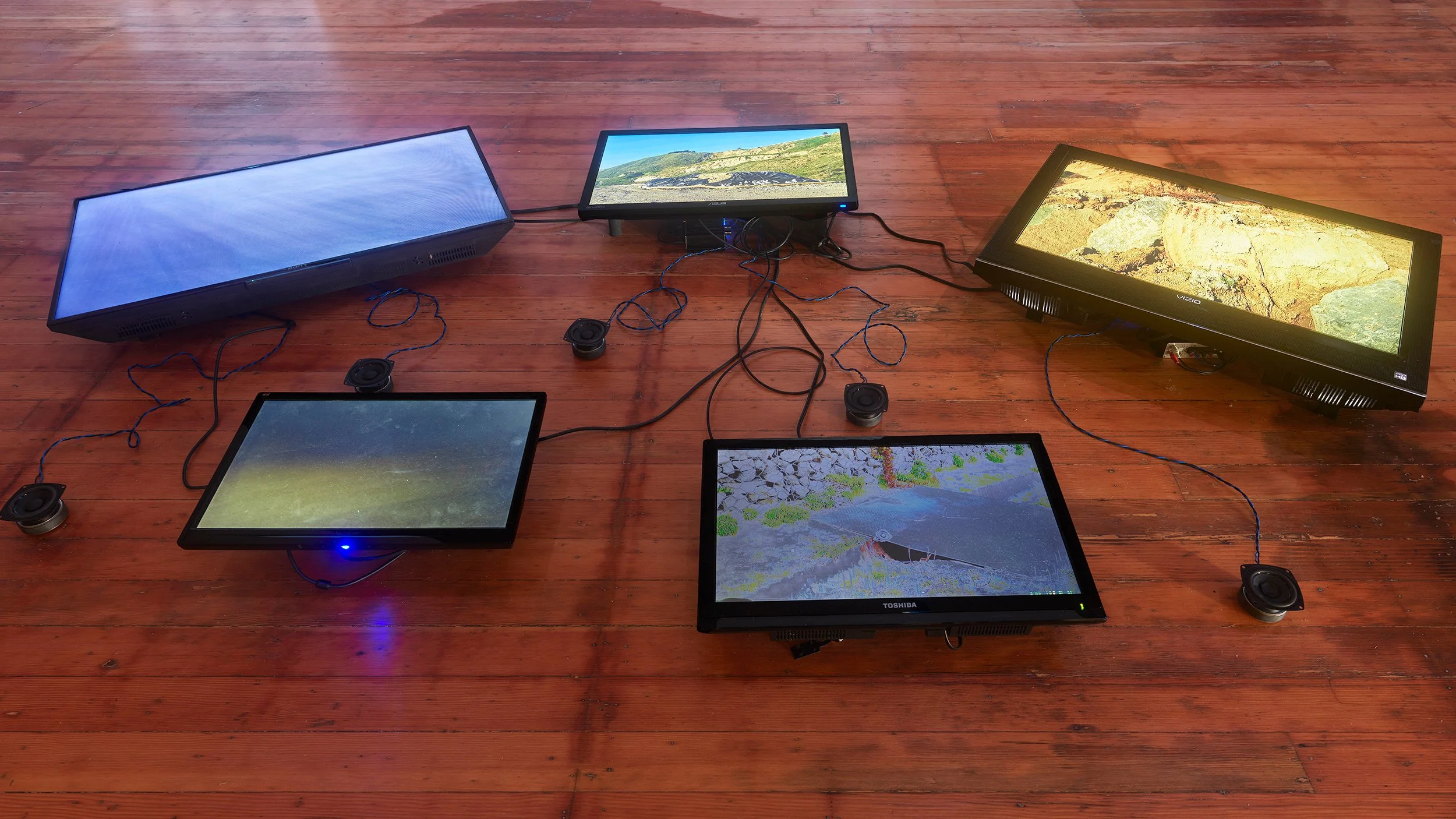
Ground Figures is an iteration of artistic fieldwork for noticing and intervening at Mussel Rock Park, the decommissioned landfill in the rift zone landslide where the San Andreas Fault crosses land and sea at the southwestern edge of Daly City, California. I became interested in this place in 2019 and have visited regularly since then to walk, listen, record, photograph, draw, write, share the place with friends, pick up trash, assist with habitat restoration, and make uninvited creative interventions for performance and feedback-based sound installations. These different ways of gradually forming a relationship with the place (a relationship I perceive to be reciprocated by the land I’ve come to feel accountable to, as it keeps calling me back) have led me to learn how others speak of and look at Mussel Rock through library archives, policy documents, community engagements, and published texts. Traces of these interpretations inform this five-channel work for video and sound, woven together with a place poem. The project exists thanks in part to an invitation from Andrew C. Smith to participate in the wet and the dry at The Lab in San Francisco, the first exhibition of a three-year curatorial project with the compost pile as its model.
Turning the earth is essential to cultivating compost. Over the years of noticing subtle and dramatic changes at Mussel Rock Park brought about by elemental and industrial forces, the phrase “moving the earth around again” has echoed in my mind. Elemental forces of seismic tremors, sedimentation, atmospheric rivers, fog, tides, and erosion continue to shape the landscape as do industrial terraforming practices which attempt to stabilize the active landslide which might just empty the contents of the landfill into the Pacific Ocean. Infrastructural features of revetment, gabions, culverts, grates, pipes, sandbags, woodchips, and heaps of soil brought in from elsewhere reinforce the local stone, soil, and flora which make up the ground partly encapsulating decades worth of urban and industrial waste at Mussel Rock. When this earth is turned today, landfill seepage and infrastructure fragments are revealed as strata in a mixed use environmental feedback loop.
Ground Figures is a collection of field recordings which practice listening and sounding while rejecting notions of purity from early frameworks of acoustic ecology by focusing on features of industrial infrastructure and traces of erosion as acoustic filters in an “open space” park. This approach attunes to the polyphony of a post-industrial ecology wondering who and what emerges or obscures through temporal layers of land use designation and remediation. Meeting Mussel Rock in its present conditions, it is possible to consider multiple dimensions of the land not in the closed chronology of linear history presented on interpretive signage, but as strata composing a lively presence of place. In this way questions of collaborative stewardship, land rematriation, and relationship are imaginable outside the doomsday narrative of Anthropocene damage and contamination, and in opposition to the telos of settler futurity which avoids accountability at all costs. With all this in mind, the project is not particularly concerned with field recording as a genre of experimental music, nor the cartography of sound mapping, nor linear narrative as a mode of documentary or video art, nor the insistence of land art to make monuments to site-specificity. Acknowledging each of these as aesthetic traditions without predetermining a particular form or value, this project is a preference for improvisation while following and tracing a dynamic landscape. This approach extends to the detail that each video monitor for the multichannel work was found discarded on sidewalks near The Lab in the weeks leading up to the exhibition.
Ironically, the traces and interventions which make up Ground Figures began as ephemeral practices to question my impulse for making location recordings. Part of this project was made during a UC Santa Cruz course titled “Environment as Media,” taught by Anna Friz whose work is also featured in “The Wet and the Dry.” Several years back I attended a presentation by visiting artist and scholar Budhaditya Chattopadhyay in Ernst Karel’s “Reality Based Audio” course at UC Berkeley. A student asked Chattopadhyay “how do you know when to start a field recording?” He replied something like “sometimes it’s best not to record.” After a funny silence filled the auditorium for a moment, he clarified that until we begin to feel a relationship with a place, the reason to start recording might elude us. Not long after this I read Mark Peter Wright’s book Listening After Nature which works through ethical concerns in field recording practices, including how not to disappear one’s positionality as a listener when making a recording, and asking if consent from nonhuman presences is possible at all when recording an environment. More recently, in separate conversations with Bay Area artists and fellow performance collaborators Aine Nakamura and Ava Koohbor, a question of why to record at all, and a refusal to record at all, became key points of discussion. All of this has woven a particular synthesis in my mind as I continue to translate fieldwork into fixed media. So why make a field recording? In one sense because amplifying elements of a landscape which are visually, politically, and structurally critical but otherwise inaudible is a way to participate in and notice the multidimensionality of a place. In another sense recording shares a personal relationship with a landscape to invite conversation between different perspectives on places and practices. I express gratitude to each person named here for saying something which challenged and informed this project. I express gratitude to the land at Mussel Rock. I express gratitude to Andrew C. Smith and Anthony A. Russell who helped realize this exhibition with technical support and help collecting sidewalk video monitors, and to you who are reading this for visiting the exhibition and picking up this booklet.
ground figures
of tremors and transit
moving the earth around again
an ordinary sequence of disturbance
in pressure and polyphony
walking while sinking in the landfill landslide
attempting to notice
what arrives and departs in a rift
indulging in failures
of communicable measures of scale
listening in semi-transparency
an inheritance of synthetic sedimentation
as land asks us to carry
technofossil amulets
unearthed by the elements
—Kevin Corcoran
* * *
Comprised of five channels of video shown on computer monitors and television screens found on various Mission District sidewalks in February and March 2026, Kevin Corcoran’s Ground Figures: Moving the Earth Around Again takes the decommissioned landfill at Mussel Rock as its boundary investigation. Although decommissioned in the 1970s, the landfill continues to release garbage into the Pacific Ocean as a result of ongoing coastal erosion. By some measures a field recording, by other measures a site-specific performance, and by still others in conversation with the history of land art practices, Corcoran’s work claims a vital agency for this slow-moving dissolution of boundaries and environmental disaster. Did we actually think anything could truly remain separate forever?
In the video component of the installation, Corcoran performs as a surveyor, measuring the site with a yardstick, walking the perimeter of garbage heaps, and variously creating sound in a more performative sense through a combination of speaker feedback and microphone abuse. The subject is always present, whether as a microphone (the receiver) or as a speaker in the frame, or at times Corcoran himself. Yet as Corcoran’s work measures fluctuations through extended shots of audio feedback across distances, it captures the exterior space as much as the subject. Across multiple recordings and occurrences, the notion of an “exterior space” is further complicated by recordings made from within resonant tubes, dragged microphones, and other methods of transcribing the site and even the action of recording itself.
Finally, the measuring of this site is in part a cataloging of the geologic time of erosion. This seepage of the landfill into the ocean, this slow catastrophe, is what the theorist Elizabeth Povinelli might call a quasi-event:
… a form of occurring that never punctures the horizon of the here and now … The quasi-event is only ever hereish and nowish and thus asks us to focus our attention on the forces of condensation, manifestation, and endurance rather than on the borders of objects.
The process of erosion at the geological level is one of a gradual dissolution and confusion of boundaries, rather than a clean break. The “before” and “after” of the event cannot be kept separate, as the event itself is a process rather than a moment.
—Andrew C. Smith
Anna Friz with Pamela Rodríguez-Montero: Hole in the Wall (2026)
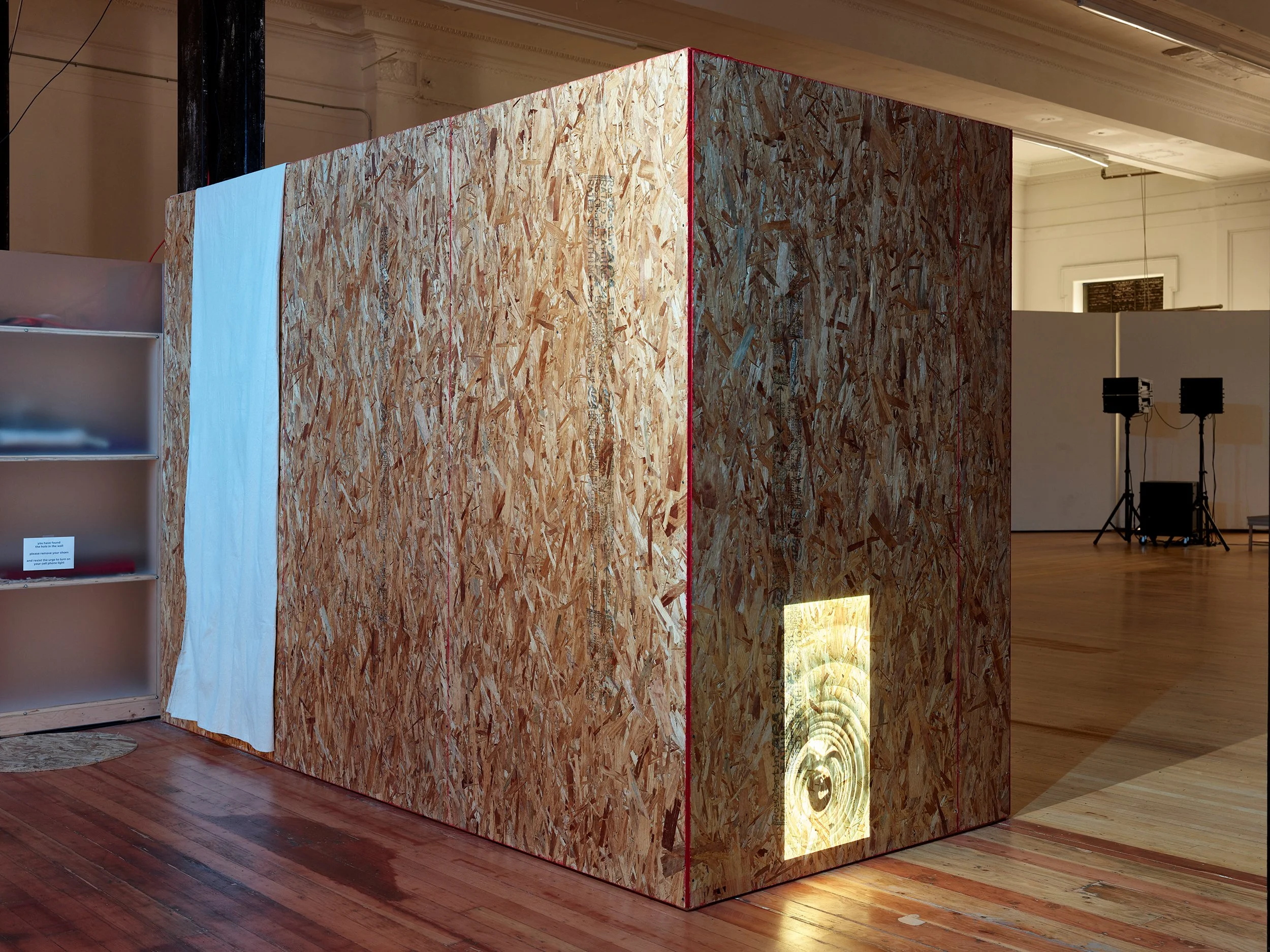
I have lived in more than one apartment where eventually animals moved in too: rats in the subfloor and under the bathtub, raccoons in the interior walls and the attic, a Jerusalem cricket hissing in the living room behind the curtain. Lately pocket gophers engineer the underground all around me, tunneling underneath my apartment and throughout the meadow outside. Holes are part of building and neighbourhood infrastructures, and some creatures travel easily through them. Typically, the animals that are adapted to life underground are often considered abject or disgusting, but rodents and worms and insects bear unique relationships to decaying and composting matter, and they find shelter in the small tight spaces in the dark corners of human life as easily as underground.
In classic myths, a human descends into the underworld in search of a lost loved one. The mortal protagonist finds their way with the help of various guides but retains a human body and self throughout the journey, but the everyday reality of going underground actually requires either technology or metamorphosis. How would a human need to transform physically in order to visit the potentially vast world of creatures and organisms that live in the dark of the earth, to reach the underworld and the lands of the dead? How will you know the dead when you meet them?
A hole in the wall is an invitation to rodent space and a curiosity about adaptation and visitation. The piece is part of a suite of audio works reconsidering metamorphosis and the underworld.
—Anna Friz
* * *
Anna Friz’s Hole in the Wall, created with Pamela Rodríguez-Montero, is a multichannel sound installation in near-total darkness inside a sound insulated wall built on-site in the gallery. The installation very literally asks the observer to crawl, hands and knees, through a hole in a wall into a “burrow.” Inside, one will have the sense of being “in-between” the walls; the surrounding scratching and scraping has a tactile quality in part due to its proximity to the ear and the disorienting nature of being in darkness.
Friz has noted the gopher as a go-between from the surface to the underworld. The gopher does not merely act on the interface, but instead crosses the membrane. The gopher becomes an emissary between worlds, “abject or disgusting” due to its proximity to the dirt, but also a magician, disappearing from one place and appearing in another. The gopher transforms the face of the earth from a surface into a volume.
The video component for this work, projected at a low height on the outside edge of the wall, as well as the headphone audio on the exterior of the wall, originated for a piece with narration entitled Revenant (2020). In that work, Friz asks “What kind of organism do I need to become to burrow down to the underworld, to seek out lost mortal love?” A journey to the underworld requires transformation into an abject creature—a worm, an insect, a rodent—as these are the creatures that quite literally turn the earth.
—Andrew C. Smith
Whitney Vangrin: Sour Coil — Cycle One (2026)
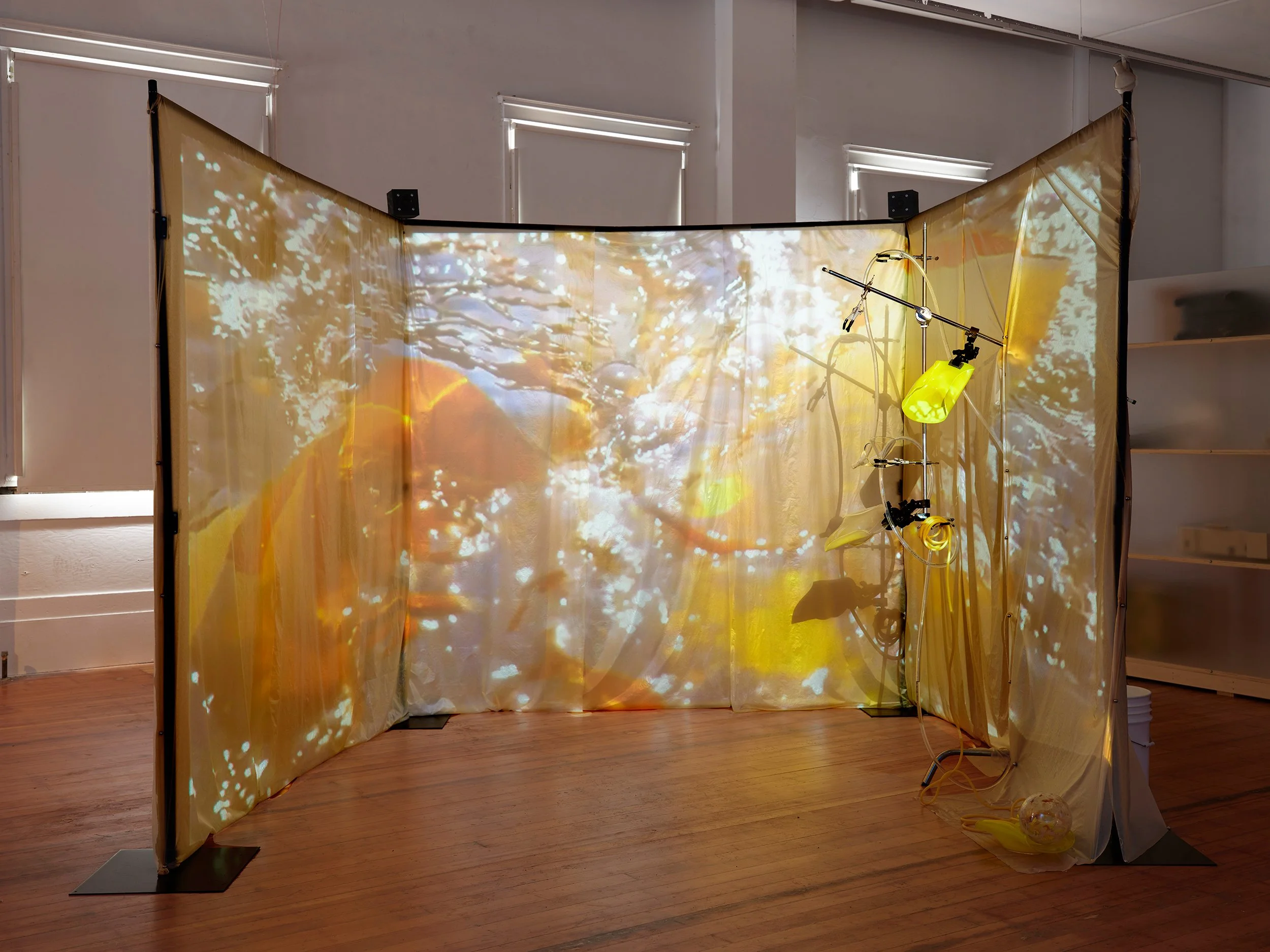
Sour Coil – Cycle One is a performance and immersive installation that merges the symbiotic traditions of fermentation with the efforts of kelp restoration to explore themes of fecundity, survival, and resilience. The work centers on the body’s role as a conduit of transmission, as well as the complexities of ecological attunement and interspecies collaboration.
The piece incorporates a film composed of kelp restoration footage captured at UC Davis Bodega Marine Laboratory, where researchers are engaged in the restoration of Northern California bull kelp forests, as well as fermentation footage filmed at The Cultured Pickle in Berkeley. Bringing these sites into dialogue, the work connects microbial and marine systems through shared processes of cultivation, transformation, and care.
The installation features a freestanding cube-like structure with a membrane made from the material innovation startup Sway’s TPSea Flex film. TPSea Flex film is a seaweed-based compostable material whose regenerative qualities extend the conceptual framework of the piece. Within the cube stands a glass and metal fountain, evoking forms found in kelp forests, microbial cultures, tubing systems, and industrial scaffolding.
The piece will be activated through a live performance unfolding in front of the freestanding structure. The performance begins with the triggering of the fountain, which flows with chilled kelp and umeboshi tea and offered to the audience as a sensory initiation. This shared ingestion becomes part of the work itself, activating taste, smell, and touch as pathways of participation.
Physical actions include the playing of the jaw harp, a sonic instrument rooted in breath, vibration, and bodily resonance. Immersive sound design will be built from field recordings, fragments of medieval Slavonic chant, Carpathian fiddlers, and a soundscape created by Andy Xu on experimental cello. These gestures unfold as ritualized arrangements that induce trancelike states, dissolving distinctions between performer, material, and environment. Movements draw from microbial choreography, regenerative labor, and multispecies coordination, where each action becomes a metaphor for collaborative endurance and tacit knowledge passed through touch, repetition, and embodied practice.
The installation suggests both laboratory and ritual site, oscillating between scientific observation and embodied ceremony. Through this multisensory exchange, Sour Coil – Cycle One invites collective presence as a strategy for endurance within unstable ecological conditions.
—Whitney Vangrin
* * *
Whitney Vangrin’s work Sour Coil – Cycle One accumulates logics of equivalence through juxtaposition of scale. The work is an approximately hour-long video of close-ups of kelp forest restoration and fermentation projected onto a thin layer of kelp-based packaging material. A fountain of bent glass plates and surgical tubing bursts through the side of the material, an apparatus that calls to mind complex fermentation mechanisms and medical procedures. Vangrin’s installation explores this relationality between the system at work and the efforts to control it.
In fermentation, as in compost, one of the primary mechanisms of control is the environmental factors: the temperature, moisture content, and acidity of the system. These environmental states are often influenced by both humans and by the process itself—healthy compost gets hot—but the internal metabolic workings of the fermentation process are not under direct human control. The environment becomes a sort of interface, a way of shaping the behavior of the system without necessarily needing to understand its particulars.
The more efforts to control a system from an outside vantage point are deemed effective, the more the means of access to that system appear equivalent to the actual events internal to the system. When such apparent equivalence is viewed as more than provisional, one finds the illusory claim that whatever has gained power to externally impose control over a system holds an equivalent control over the internally generated processes that define that system, and so total control of the system itself.
In cybernetics terms, this is referred to as a black box, because although the system itself might provide an impression of control, the inner workings are hidden from the user. Hookway hints at this notion of the black box when he warns of an “illusory claim” that power over a system translates to an understanding of its internal workings. The interface, in creating this relation, also separates the “interior” of each space from the other. The site of the relation becomes an epistemological boundary. The claim to control is an illusion; we are just collaborators.
Vangrin’s practice explores endurance and the guiding of an environment. Across her work, she examines processes and relations: falcon-falconer, scientist-kelp forest, and chef-ferment are all models of interspecies collaboration and forms of collaborative governance. In working across scales from the microbial to the vegetable to the avian, she shows commonalities of modes of collaboration that decenter the human as direct controller. In fact, the subject itself becomes multiple, as the community of microbes asserts its agency. As Jane Bennett writes in Vibrant Matter, “The its outnumber the mes. In a world of vibrant matter, it is thus not enough to say that we are “embodied.” We are, rather, an array of bodies, many different kinds of them in a nested set of microbiomes.”
—Andrew C. Smith